Pirate Slot Themes and the Evolution of Treasure-Hunt Bonuses
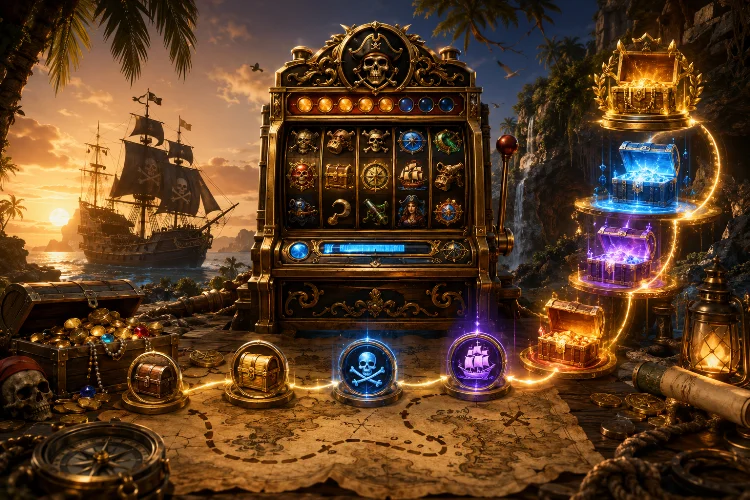
A pirate slot from fifteen years ago and a modern pirate release may share the same basic ingredients—ships, gold coins, skulls, and treasure chests—but the way those ideas are used has changed considerably. Today’s games can turn a simple treasure hunt into a multi-stage bonus involving collection meters, persistent symbols, multipliers, respins, player choices, and changing reel layouts.
That evolution makes Pirate Slot Themes a useful example of how online slot design has developed. The theme itself remains instantly recognizable, but developers now have far more ways to connect pirate storytelling with game mechanics.
Compare NetEnt’s Ghost Pirates from 2010 with newer titles such as Pirates Party from 2024 or Play’n GO’s Sails of Riches from 2026, and the growing complexity of bonus design becomes easy to see.
Early Pirate Slots Relied on Familiar Bonus Structures
Older online slots generally had fewer layers of interaction.
NetEnt’s Ghost Pirates, released in April 2010, uses a 5×3 layout with 243 betting ways. Its key features include wild substitutions, scatter symbols, and free spins where wins receive a three-times multiplier.
That structure is relatively easy to understand.
Land enough scatters, enter the free-spin round, and continue playing with an additional modifier.
The pirate artwork provides personality, but the game does not require several progress meters or nested bonus systems.
Modern releases often take a different approach.
Treasure Collection Became a Mechanic of Its Own
Collecting valuables is almost unavoidable in pirate fiction, making it ideal for modern slot features.
Instead of treasure being represented only by high-value symbols, newer games can ask players to gather special objects over several spins.
Pragmatic Play’s Pirate Gold requires eight money bags to activate its Respin Round, where treasure values, multipliers, and jackpots can appear.
Pirates Party uses a different collection system. Players gather 30 Bonus symbols to enter the Helms of Luck Bonus, where tokens can be spent across three different helm options offering various prizes or access to Free Spins.
The treasure hunt has effectively become a progress system.
Instead of simply waiting for one bonus symbol combination, the player can see a feature gradually developing.
Maps Turn Free Spins Into a Journey
Treasure maps may be the most obvious pirate-game symbol, but they become much more interesting when developers make them functional.
Play’n GO’s Jolly Roger 2 does exactly that.
Its Treasure Map Hunt awards an initial ten free spins. During those spins, players collect four pieces of a treasure map. Completing the map leads to a buried-treasure location that activates a modifier for the remaining spins, and completed maps can also award additional free spins.
From a design perspective, this creates a simple sense of progression.
You are not just counting down from ten spins to zero. You are trying to complete something before the feature ends.
That can make the bonus feel more like a short game-within-a-game.
Pirate Stories Make Collection Easy to Understand
A progress mechanic does not necessarily need complicated instructions when its visuals make sense.
Four torn map pieces obviously suggest one completed map.
Several gold bags suggest accumulated loot.
A ship moving toward the horizon suggests a voyage getting closer to its destination.
The theme handles part of the explanation, which can make relatively complex systems feel more accesible.
Free Spins Have Become More Customizable
Another change is that modern bonus rounds increasingly offer variations rather than one standard free-spin mode.
NetEnt’s Pirates Party allows players to choose from three Free Spins options after landing scatters on reels one, three, and five. One option provides 15 spins with a five-times multiplier, another offers 10 spins with random wilds, and the third provides five spins with colossal wilds.
That is quite different from the more straightforward Free Spins structure in Ghost Pirates.
Choice does not necessarily mean the player can improve the game’s mathematical return by selecting perfectly. Each option belongs to the game’s predefined design.
What it does provide is a stronger sense of interation.
The player gets to decide which style of bonus they want to see.
Wilds Have Become Characters and Game Objects
Classic wild symbols usually had one simple purpose: substitute for other symbols.
Modern pirate games can give wilds more elaborate behaviour.
In Captain Glum: Pirate Hunter, Ship Wilds move to random positions on the reels, while the Golden Flagship Pirate Ship Wild can become permanent. The game also uses Connecting Wilds and a Multiplying Mortar during its pirate-battle features.
Pirates Pub takes another route. During the bonus, a wild leaves a frame behind. If another wild later lands in the same position, it can generate a multiplier of up to five times.
The important design change is that a wild is no longer always a static substitute symbol.
It can move, stay, upgrade, connect, or influence later spins.
Pirate imagery gives designers plenty of objects—ships, flags, captains, cannons—to explain these behaviours in a way that feels naturaly connected to the story.
Respins Fit the Idea of Digging for Treasure
Hold-and-respin-style mechanics have also found an obvious home in pirate games.
Pirate Gold Deluxe uses a 4×5, 40-payline setup and includes a Lucky Treasure Bag Feature with a listed Grand Jackpot of 1,000 times the bet.
Sails of Riches uses its own Cannon Defense Lock feature. Landing six Gold Coins starts the round with the coins locked and three respins. New coin symbols reset the remaining respins, and their multipliers are totaled when the sequence finishes.
This kind of mechanic works thematically because every new coin feels like another piece of loot being added to the haul.
The player can instantly understand the visual goal: fill more positions with treasure before the opportunity ends.
Modern Pirate Slots Use Persistent Visual Progress
Newer games can also show progress outside a traditional bonus round.
In Sails of Riches, collected Gold Coins are visually sent toward a pirate ship in the distance, which changes through several visual stages. Play’n GO specifically notes that this apparent progress does not influence when the jackpot is awarded.
That clarification is important.
Modern interfaces can make a feature look as though it is getting “closer” even when the visual state is not a probability meter.
Players should therefore read the game rules instead of assuming that a ship appearing nearer, a chest looking fuller, or a meter being almost complete automatically means a major award is imminant.
Visual storytelling and mathematical probability are not always the same thing.
Pirate Bonuses Have Become Mini-Games
Perhaps the biggest evolution is the movement from passive bonuses toward small interactive sequences.
Jolly Roger 2 includes several selectable Bonus Quest concepts, including battles against armadas, picking rum bottles, and completing treasure maps.
Captain Glum: Pirate Hunter uses a pirate-versus-pirate-hunters showdown during free spins, with the result connecting to additional multiplier features.
These are still slot features rather than skill-based adventure games.
However, their presentation borrows ideas from wider video gaming: objectives, characters, progress, choices, battles, and reward sequences.
That makes the experience feel more involved than simply watching an automatic reel bonus.
Familiar Symbols Still Matter
Even with increasingly elaborate mechanics, pirate slots rarely abandon their recognizable visual vocabulary.
Pragmatic Play’s Pirate Golden Age uses pirates, parrots, anchors, and skull wilds. Its free-spin feature adds mystery coins that can be collected and redistributed, with repeated coins creating multipliers.
These symbols matter because players understand the world immediately.
A futuristic game may need to explain what a fictional energy crystal does. In a pirate game, gold is valuable, a map leads somewhere, and a treasure chest probably contains something worth finding.
That immediate familiarity gives designers room to make the underlying mechnics more elaborate without making the entire experience feel unfamiliar.
Theme and Mathematics Should Still Be Separated
A complicated pirate bonus does not automatically mean a slot has better RTP, higher winning chances, or a more favorable payout structure.
Those characteristics depend on the mathematics of the individual game.
For example, NetEnt currently publishes different RTP and maximum-payout figures for Ghost Pirates and Pirates Party, even though both use broadly similar pirate imagery.
Players should therefore use the theme to judge entertainment style and use the paytable, RTP, volatility information, and rules to understand how the game actually operates.
A giant pile of animated gold is still a presentation choice.
Pirate Slot Themes have evolved from simple reel games into more elaborate treasure hunts filled with collecting mechanics, choice-based free spins, moving wilds, maps, respins, and mini-game-style bonuses. The pirate setting works because these features naturally fit stories about exploration and hidden wealth.
When comparing games, enjoy the adventure but also check how each feature really works before treating visual progress as a guarentee of a reward.