
Is Wireless Charging Here to Stay? Evolution, Limitations, and the Future of Wireless Charging
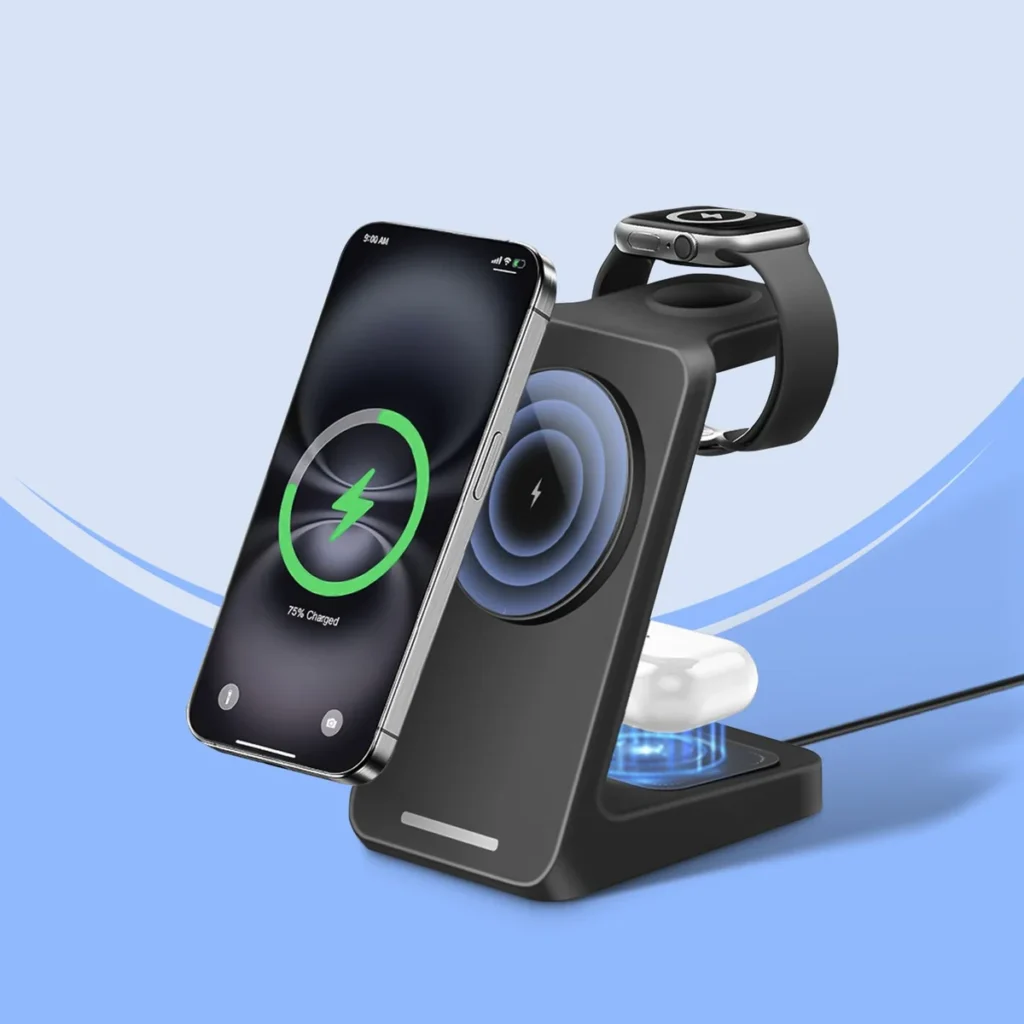
Wireless charging has gone from technological curiosity to standard functionality in premium smartphones. With the Qi2 standard establishing a universal 15W specification and manufacturers like Xiaomi announcing 80W wireless charging, the technology has matured significantly. But important technical limitations still shape its role in the mobile charging ecosystem.
The physical principle of wireless charging is electromagnetic induction: a transmitter coil in the charger generates an alternating magnetic field that induces electrical current in a receiver coil in the smartphone, which is then converted to direct current to charge the battery. The efficiency of this transfer is the main technical challenge: while wired charging can operate above 95% energy efficiency, wireless charging typically operates between 75% and 85%, with the remainder dissipated as heat.
The Qi2 standard, developed by the Wireless Power Consortium with technical input from Apple, introduced mandatory magnetic alignment as a certification requirement. This ensures that Qi2-certified devices always position themselves at the optimal energy transfer point on the charger, eliminating the frequent misalignment problem that reduced efficiency and increased heat generation in original Qi. Apple’s MagSafe, which inspired Qi2, uses a ring of permanent magnets in both the device and charger to ensure this alignment automatically.
Wireless charging speeds have advanced considerably. Qi2 specifies 15W as a baseline, while proprietary protocols reach much higher speeds: Xiaomi HyperCharge reached 80W wireless in laboratory environments. However, ultra-high wireless speeds generate considerable heat in both the charger and the device, requiring active ventilation systems in chargers and limiting usage position during charging.
Reverse wireless charging, which allows the smartphone to function as a wireless charger for other devices, remains a power-limited feature. Most implementations offer only 5W output, sufficient to charge TWS earphones like AirPods or Galaxy Buds, but impractical for efficiently charging other smartphones.
Current limitations of wireless charging include: the need for static device positioning (you cannot use the smartphone normally while charging wirelessly); lower energy efficiency compared to wired; incompatibility between high-speed proprietary protocols (a 50W wireless VOOC charger doesn’t work with iPhone); and higher cost of certified accessories.
The most promising technological future is distance wireless charging. Companies like Energous (WattUp) and Ossia are developing radio frequency or ultrasound energy transfer systems that work at distances of one to two meters, without the need for precise positioning. The transferred power is still low (1W to 3W), insufficient for primary charging, but viable for passively keeping IoT devices and earphones charged in home environments.
Wireless charging is convenient, standardized with Qi2, and will continue evolving in speed and versatility, but it is unlikely to completely replace wired charging in applications that demand maximum speed and energy efficiency in the coming years