Why AI Will Change How We Use the Internet Forever
Introduction
For most of its existence, the internet has been a place you navigate.
You open a browser.
You type a query.
You click links.
You move from page to page.
That’s how we’ve all been trained to use it.
The internet has always been something you explore.
But that behavior is starting to change.
More people are no longer navigating the internet in the traditional way. They’re not jumping between websites, opening dozens of tabs, or scanning long articles.
Instead, they’re asking questions and getting direct answers.
And the system responding isn’t a website.
It’s AI.
This shift is subtle, but it’s one of the most important transformations happening right now. Because once AI becomes the main interface between users and the internet, everything about how we use it begins to change.
The Internet Was Built for Navigation
The original structure of the internet is based on links.
Every piece of information lives somewhere, and users move between these pieces by clicking.
Search engines made this process easier by organizing information, but they didn’t change the core behavior.
You still had to:
- search
- choose a result
- visit a site
- extract information
The responsibility was always on the user.
The internet gave access — but not answers.
AI Turns the Internet Into a Layer
AI changes this completely.
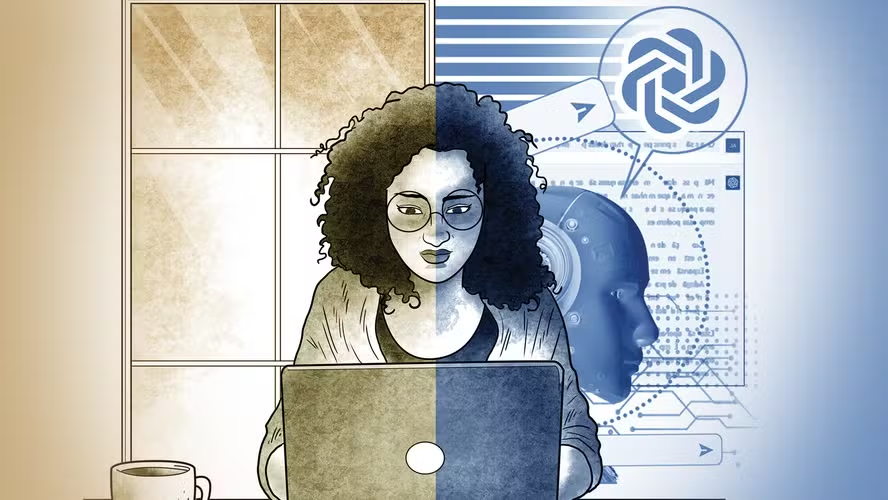
Instead of navigating the internet, users interact with a system that sits on top of it.
You don’t go to multiple websites anymore.
👉 The system goes for you.
It collects information, processes it, and delivers something usable.
That transforms the internet from:
👉 a collection of pages
into:
👉 a layer of knowledge
And once that happens, the need to navigate disappears.
From Exploration to Interaction
This is the core shift.
Before:
👉 you explored the internet
Now:
👉 you interact with it
That may sound small, but it changes everything.
Exploration requires effort.
Interaction feels natural.
When users can simply ask:
“Explain this to me like I’m a beginner”
“Summarize this topic”
“Give me the best option based on my situation”
They stop thinking in terms of websites.
They start thinking in terms of results.
Why This Is Happening Now
This shift is happening because multiple factors are aligning at the same time.
1. AI Can Understand Context
Older systems relied on keywords.
AI understands meaning.
It can interpret:
- intent
- tone
- complexity
This makes interaction feel human.
2. Information Overload Reached a Limit
There’s too much content online.
Users are tired of filtering.
They don’t want more information.
👉 They want clarity.
AI provides that.
3. Speed Became Essential
Modern users expect instant results.
Waiting, searching, comparing — all of that feels slow.
AI removes those steps.
What Changes for Users
This shift changes user behavior in several ways.
Less Clicking
Users don’t need to visit multiple sites.
They get answers directly.
Fewer Tabs
The “multiple tabs” workflow disappears.
Everything happens in one place.
Faster Decisions
With summarized information, decisions become quicker.
What Changes for Websites
This is where things get interesting.
If users stop visiting websites directly, traffic patterns change.
Content is still important — but it’s consumed differently.
Instead of:
👉 users going to content
It becomes:
👉 content going to users through AI
This changes:
- SEO strategies
- content structure
- how visibility works
The Risk of Centralization
There’s a major downside to this model.
If AI becomes the main interface to the internet:
👉 it becomes a gatekeeper
Instead of users choosing sources, the system chooses for them.
This creates:
- less diversity in information
- more influence from platform providers
- potential bias
The open nature of the internet could become more controlled.
The Loss of Discovery
One of the most powerful aspects of the internet is discovery.
You search for one thing and find something unexpected.
AI reduces that randomness.
It gives you exactly what you ask for.
That’s efficient — but also limiting.
Serendipity becomes less common.
What Happens Next
The internet is not disappearing.
But its interface is changing.
We’re moving toward a model where:
- AI sits between users and information
- websites become data sources
- interaction replaces navigation
Over time, this will feel normal.
Just like search engines once replaced directories, AI will replace traditional browsing.
The Bigger Shift
This isn’t just about convenience.
It’s about control.
When AI becomes the main interface, it controls:
- what you see
- how you see it
- how information is presented
That’s a powerful position.
Conclusion
The internet used to be something you explored.
Now it’s becoming something that responds to you.
AI is not just changing how we access information.
It’s changing how information is delivered, processed, and understood.
And once users adapt to this new model…
👉 going back to the old way will feel unnecessary.